
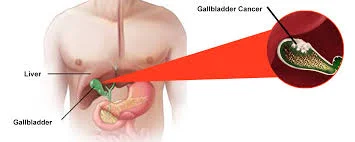
Overview of Gallbladder Cancer
Gallbladder cancer is a rare but aggressive malignancy originating in the gallbladder, a small organ beneath the liver that stores bile. Predominantly adenocarcinoma, it is notably prevalent in India, particularly in northern regions like the Ganga valley, where it ranks among the top biliary tract cancers due to high gallstone incidence. Globally rare, it affects women more than men, often after age 65. Major risk factors include chronic gallstones (present in 75-90% of cases), gallbladder inflammation (cholecystitis), porcelain gallbladder, polyps, obesity, and infections. In India, dietary factors, typhoid carriers, and environmental exposures contribute to elevated rates.
Symptoms, Diagnosis, and Surgical Management
Symptoms are often vague and late-appearing: right upper abdominal pain, jaundice, unexplained weight loss, bloating, fever, or palpable lumps. Many cases are incidentally discovered during cholecystectomy for gallstones.
Diagnosis involves ultrasound as initial screening, followed by CT/MRI/PET-CT for staging, tumor markers (CA 19-9, CEA), and biopsy via endoscopy or laparoscopy. Staging ranges from 0 (in situ) to IV (metastatic), with early stages offering better prognosis.
Surgery is the only curative option for resectable disease. For early (T1a) tumors, simple cholecystectomy suffices. Advanced cases require radical (extended) cholecystectomy: gallbladder removal en bloc with liver wedge resection (segments IVb/V), regional lymphadenectomy, and possibly bile duct excision.
Dr. Kapil Kadian employs advanced minimally invasive techniques, including laparoscopic or robotic-assisted radical cholecystectomy, minimizing blood loss, pain, and recovery time while ensuring oncologic clearance. Staging laparoscopy avoids unnecessary open surgery in unresectable cases.
Adjuvant chemotherapy (gemcitabine-based) or chemoradiation follows for node-positive or margin-positive resections. Palliative stenting relieves jaundice in advanced disease.
Prevention emphasizes managing gallstones—prophylactic cholecystectomy for high-risk (large stones, porcelain gallbladder)—healthy weight, and infection control. Early-stage resection yields 5-year survival >60-80%; overall prognosis improves with expert multidisciplinary care focused on precision surgery.